Central AC System Maintenance: A 2026 Guide

Table of Contents
What Central AC System Maintenance Includes
How Often to Change Your AC Filter
Step-by-Step Maintenance Tasks You Can Do Yourself
Replacing the Air Filter
Cleaning the Outdoor Condenser Unit
Clearing Debris Around the Exterior System
Cleaning the Condensate Drain Line
Signs Your AC Needs Professional Service
Professional Maintenance Tasks and HVAC Tune-Up Costs
Creating a Seasonal Maintenance Schedule
Frequently Asked Questions
Last Updated: September 27, 2026
What Central AC System Maintenance Includes
Central ac system maintenance encompasses both simple tasks homeowners can handle and professional work that requires a licensed technician. The goal is to keep your system running efficiently, extend its lifespan, and avoid costly emergency repairs during the hottest months.
Here's what falls under central ac system maintenance:
Replacing or cleaning air filters monthly
Clearing debris from the outdoor condenser unit
Cleaning the condensate drain line
Checking refrigerant levels
Inspecting evaporator coils
Testing electrical connections
Cleaning fan blades
Scheduling annual professional tune-ups
How Often to Change Your AC Filter
Your air filter is the first line of defense for your HVAC system. A dirty filter forces your system to work harder, wastes energy, and reduces airflow. Change your filter every 30 days during cooling season (every 15 days if you have pets or allergies). A clogged filter reduces cooling efficiency, increases energy bills, and strains the compressor (HVAC Proper Installation of Filters).
Home Guard
Pro Tip Write the filter size and replacement date directly on your new filter with a marker. This prevents confusion when you're standing at the hardware store and can't remember if you need a 16x25x1 or 20x25x1.
Step-by-Step Maintenance Tasks You Can Do Yourself
These tasks are safe for homeowners and take about an hour total. Perform them at the start of cooling season and again mid-summer.
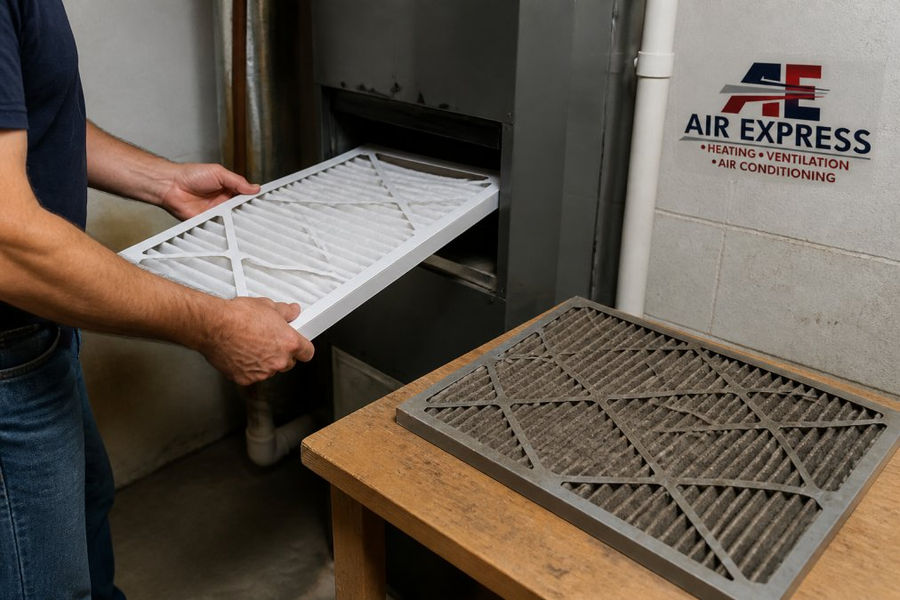
Replacing the Air Filter
Your filter slides into a slot near your furnace or air handler. Turn off your system, locate the filter housing, note the size, remove the old filter, and insert the new one with the arrow pointing toward the furnace. The arrow shows airflow direction, install it backwards and your system works inefficiently.
Cleaning the Outdoor Condenser Unit
Your outdoor condenser unit releases heat outside. Leaves and debris block airflow and reduce efficiency. Turn off power at the breaker, remove loose debris by hand, use a soft brush to clean the fins, and rinse with a garden hose on low pressure. Never use a pressure washer, high pressure damages the fins and pushes debris deeper into the coils.
Clearing Debris Around the Exterior System
Keep the area around your outdoor unit clear. Trim vegetation at least 2 feet away, remove leaves and sticks from the base and top, and ensure nothing blocks the airflow vents. A blocked condenser works twice as hard, shortening its lifespan and increasing energy costs.
Cleaning the Condensate Drain Line
Your air conditioner removes moisture through a small PVC pipe called the condensate drain line. When it clogs, water backs up and damages your system. Locate the drain line near your indoor unit, flush it with a wet/dry vacuum for 5-10 seconds, and pour a cup of white vinegar down it monthly to prevent algae growth. If water pools around your indoor unit, the drain is clogged, one of the most common reasons for emergency service calls.
Watch Out If the drain line backs up completely, water can leak into your home and damage drywall, insulation, and flooring. A small clog is easy to clear yourself. If vinegar and a vacuum don't work, call a professional.
Signs Your AC Needs Professional Service
Call for professional service if you notice weak or uneven airflow, the system won't turn on, strange noises (grinding, squealing, hissing), warm air when cooling is on, visible ice on the outdoor unit, water leaking inside, burning or electrical odors, or short cycling. These symptoms indicate low refrigerant, compressor problems, electrical faults, or evaporator coil damage. Attempting DIY fixes risks further damage and voids your warranty.
Professional Maintenance Tasks and HVAC Tune-Up Costs
A professional HVAC tune-up includes checking refrigerant levels and pressure, testing electrical connections and capacitors, inspecting and cleaning evaporator coils, measuring system airflow, checking thermostat calibration, lubricating motors and bearings, inspecting ductwork for leaks, cleaning blower components, and verifying proper drainage. These tasks catch problems early and prevent costly emergency repairs.
When to Schedule Professional Service
Technicians have more availability and can schedule you quickly
Problems discovered in spring cost less to fix than emergency repairs in July or August
Your system runs at peak efficiency when you need it most
DIY vs. Professional: When to Draw the Line
Refrigerant handling requires EPA certification (Section 608 certification under the Clean Air Act). Improper handling vents ozone-depleting refrigerants and carries federal penalties.
Electrical testing on capacitors and contactors risks electrocution. Even with the system off, capacitors hold a charge.
Evaporator coil cleaning requires partial system disassembly and specialized coil cleaner. Damage to coils during DIY attempts costs $800-$1,500 to replace.
Key Takeaway A professional tune-up can prevent costly emergency repairs and save on wasted energy costs annually. The return on investment can be immediate and compounds year after year.
Creating a Seasonal Maintenance Schedule
Consistency prevents breakdowns. Use this month-by-month schedule to stay on top of central ac system maintenance and catch problems before they escalate.
Spring (March-May): Pre-Cooling Season Preparation
Early March: Replace your air filter and inspect the outdoor unit for winter damage (bent fins, debris accumulation, standing water in the condensate pan).
Mid-April: Schedule your professional tune-up. Technicians check refrigerant levels, test electrical components, and clean coils before the heat arrives. Booking early avoids the May rush.
Late April: Clear vegetation around the outdoor unit. Trim back any branches or shrubs within 3 feet. Remove leaves and sticks from the base and top of the unit.
Early May: Run your system on cooling mode for 15 minutes to verify it starts without strange noises or weak airflow. If you hear grinding, squealing, or hissing, contact a technician immediately, these are signs of compressor wear or refrigerant leaks that worsen under load.
Summer (June-August): Active Cooling Season Maintenance
Monthly (1st of each month): Replace your air filter. During heat waves or if you have pets, check it every two weeks, a clogged filter reduces cooling capacity by 10-15%.
Monthly (mid-month): Flush your condensate drain line with a wet/dry vacuum for 5-10 seconds, then pour a cup of white vinegar down the line. Algae and mold grow rapidly in warm, humid conditions and block drainage within weeks.
Monthly (end of month): Visually inspect the outdoor unit. Remove any new debris, leaves, or grass clippings. Hose it down gently on low pressure.
During heat waves: If outdoor temperatures exceed 95°F for more than three days, check your system daily. Listen for short cycling (turning on and off every few minutes), which indicates low refrigerant or a failing compressor. If short cycling occurs, call a technician, running a low-refrigerant system damages the compressor within hours.
Fall (September-October): Transition and Inspection
Early September: Replace your air filter one final time as cooling season ends. Check the outdoor unit for any damage sustained during summer storms (hail, high winds, lightning).
Mid-September: Have a technician inspect your ductwork for leaks using a blower door test or smoke pencil. Leaky ducts waste 15-30% of your cooled air and increase energy bills. Sealing ducts with mastic sealant or metal tape can recover its cost in energy savings within a few years.
Late September: If you use a smart thermostat, review your cooling season data. Most smart thermostats log runtime, temperature swings, and humidity levels. Unusual patterns, like the system running constantly without reaching your set temperature, signal refrigerant loss or airflow problems.
October: Switch your thermostat from cooling to heating mode and test it briefly to ensure the heating system is ready for winter.
Winter (November-February): Off-Season Monitoring
Your AC isn't running, but don't ignore it entirely.
Monthly: Check that the outdoor unit is clear of snow, ice, and debris. Heavy snow or ice buildup can damage fins and block airflow when you restart the system in spring.
After winter storms: If your region experiences ice storms or heavy snow, inspect the outdoor unit for damage. Bent fins or cracked plastic components should be noted for spring repair.
February: Order your air filter in advance so it arrives before your spring tune-up. Having the correct size on hand prevents delays.
Using Smart Thermostat Alerts to Trigger Maintenance
Filter change reminders: Most smart thermostats track runtime and alert you when the filter is due for replacement. Don't ignore these, they're based on actual usage, not a calendar.
System error codes: If your thermostat displays an error code (e.g., "Low Refrigerant," "High Pressure," "Sensor Error"), photograph it and send it to your HVAC technician before scheduling a visit. This speeds diagnosis and prevents unnecessary service calls.
Runtime tracking: Review your thermostat's weekly or monthly runtime report. If cooling runtime increases 20-30% month-over-month without a change in outdoor temperature, your system is losing efficiency, usually due to a refrigerant leak, dirty coils, or clogged filter.
Temperature differential: If your thermostat shows that your system is running but not cooling (e.g., it's set to 72°F but the house is 78°F), this indicates low refrigerant or compressor failure. Call a technician immediately.
Task | Frequency | Best Time | DIY or Pro |
Replace air filter | Every 30 days (or per smart thermostat alert) | 1st of each month | DIY |
Clean outdoor unit | Monthly | May, July, September | DIY |
Clear debris around unit | Monthly | May, July, September | DIY |
Flush condensate drain | Monthly | 15th of each month | DIY |
Professional spring tune-up | Once yearly | April-May | Professional |
Inspect ductwork for leaks | Once yearly | September-October | Professional |
Check refrigerant levels | Once yearly | April-May | Professional |
Deep coil cleaning | Every 2 years | April-May | Professional |
Inspect outdoor unit for storm damage | As needed | After severe weather | DIY inspection; Pro repair |
Pro Tip Set phone reminders for the 1st and 15th of each month during cooling season. The 1st is for filter replacement; the 15th is for drain line flushing. These two tasks prevent 80% of common AC problems.
Frequently Asked Questions
How often should a central AC system be serviced?
Your central AC system should be professionally serviced at least once per year, ideally before the cooling season begins. Many HVAC technicians recommend scheduling service in spring to catch any issues before summer heat arrives. If your system is older or sees heavy use, twice-yearly maintenance (spring and fall) can extend its lifespan and improve efficiency. Between professional visits, check and replace your air filter every 1-3 months depending on usage and air quality.
What does a standard AC maintenance check include?
A professional AC tune-up typically includes inspecting the evaporator coil and condenser unit, checking refrigerant levels, testing electrical connections, cleaning the condensate drain line, inspecting ductwork for leaks, checking the blower motor, and verifying thermostat operation. The technician will also look for signs of wear on the compressor and fan blades. This comprehensive inspection helps identify problems early and keeps your system running efficiently. For specific details about what's included in Air Express HVAC's tune-up service, contact us directly.
Can I perform central AC maintenance myself?
Yes, homeowners can safely handle basic maintenance tasks like replacing air filters, clearing debris around the outdoor unit, and cleaning the condensate drain line. However, tasks involving refrigerant levels, electrical connections, and internal coil inspection require a licensed HVAC technician. Attempting these without proper training can damage your system or create safety hazards. Air Express HVAC recommends having a professional handle anything beyond simple filter and debris removal to protect your warranty and ensure your system's reliability.
What's the difference between preventative maintenance and waiting for a breakdown?
Preventative maintenance can be more cost-effective overall and helps prevent emergency repairs during peak seasons when service calls can be more expensive and technicians are in high demand. Regular tune-ups catch small problems before they become major failures, extend your system's lifespan by years, and can help keep your energy bills lower. Emergency service calls often occur at inconvenient times and can cost significantly more. With Air Express HVAC's 24/7 availability and 10-year worry-free parts and labor guarantee, you're covered either way, but preventative care keeps you comfortable and saves money.
GIVE US A CALL


Comments